You describe what you want, in your own words. Your AI does the work for you.
No course to take, nothing to install, no technical jargon to learn. The only skill it asks is describing the result you want, the way you would to a person — which is why it belongs in a county of eight thousand, not only in a city.
What this is
AI from the ground up, where people live and work: a working website for their farm, shop or office — ideal for individuals and small businesses. Development is still ongoing, but it is well past the proof-of-concept stage, and the first step is to present it to the University of Wyoming in Laramie. The second is a $10,000 request to the Wyoming Business Council for a twelve-month pilot program in Washakie County — twelve working sites, four public workshops, and the method published free.
one award · one time · nothing to renew · the county owns the result
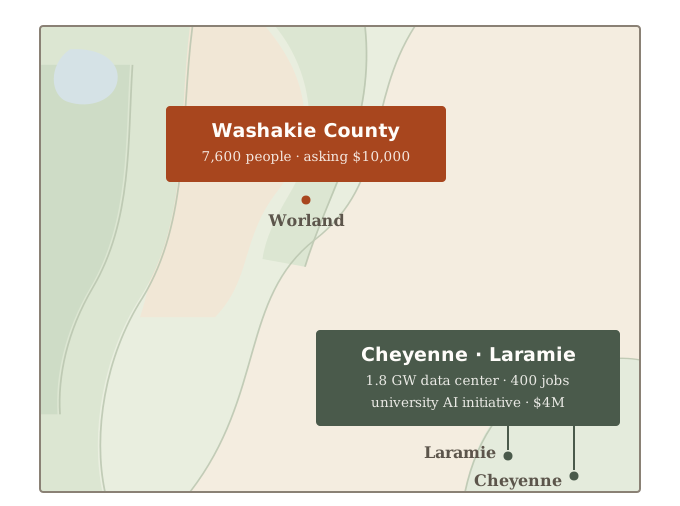
Where the state’s AI money is going — and where it is not.
This proposal is written in the new format it proposes to introduce into the county, GYR-O Pages — simple, single-topic websites generated by AI.
GYR-O = Green ·Yellow ·Red ·and sometimesOrangeGreen, yellow and red are the three columns every reader sees: plain answers, sources, technical detail. Orange is the build behind them.
Some examples already in service
worland-dog-law.onlineAn unofficial portal concisely presenting the town’s dog laws, guided by audits by Claude AI of both the official site’s user interface, and the logically-convoluted ordinances themselves. The first GYR-O Pages website, and still a quintessential example.
baconian-ciphers.onlineA daily record of academic research into the historical origins of the world-changing Binary Code, based on extensive use of Digital Image Processing.
East Bench Pivot Farm — a sample page for a Washakie County farm
An invented farm, built to show a farm here what a page of its own could look like: alfalfa hay by the bale or the ton, certified weed-free for the mountains, beef by the quarter, and sugar beets and malt barley under contract. Everything about the county, the crops, the water and the rules is real, and sourced.
We are hoping the Future Farmers of America (FFA) will want to act as ambassadors for the pilot program, bringing pages like this one to the county’s farms and keeping them up to date.
Bighorn Basin Tree Service — a sample page for a Washakie County trade
An invented tree service, built around one problem a small contractor actually has: a stranger standing in their own yard cannot tell whether the outfit quoting them is insured, and the usual proof is a folded certificate in the glovebox that nobody can check on a Saturday.
So the insurance is the first answer on the page rather than a line in a brochure, and every part of it is a link to somebody else’s check: Wyoming’s own Certificate of Good Standing for the workers’ compensation, the arborists’ register for the credential, the agent for the liability policy. Thirteen source cards cover the state fund, the OSHA clearance rule, the safety standard and the power company’s free line pruning.
Cottonwood Draw Farms — a sample page for a farm’s seasonal crew, in English and Spanish
An invented farm hiring a seasonal harvest crew, and written for the crew rather than for a customer: what the work is, what the law says they are owed, and who to call when something is wrong.
Every statement of law is sourced — twenty-two source cards, from the federal H‑2A job-offer and wage rules to Wyoming’s minimum wage, field sanitation and the local Wage and Hour office. And it carries a full Spanish peer, la misma página en español: the same answers and the same sources, not a summary.
The page layout below is standard on every GYR-O site
More Info
Uncheck anything you would rather not read
A Plain answers
What is being asked for?
Ten thousand dollars. One award, one time, from the Wyoming Business Council’s Community Economic Growth Grant1 — a program that exists to fund projects improving a community’s quality of life through economic development, and whose ceiling is exactly $10,000.
It pays for a twelve-month pilot program in Washakie County: twelve working websites built for local institutions and small businesses, four public workshops, and a written method anybody can follow afterward without paying anyone.
That is the whole ask. This grant has no second phase, no ongoing subsidy, and nothing to renew.
What would I actually have to do?
Describe what you want, in your own words. That is the whole of your part.
The way you would say it to somebody across a counter: I run a tree service. People want to know if I am insured and how fast I can come. I work the Basin from Greybull to Thermopolis. That is enough to start.
Your AI does the rest — the writing, the building, checking every fact against a source, making sure it reads on a phone and prints on paper. You read what comes back and say what is wrong with it; it is fixed, and you say what is wrong with that. If you can tell when a description of your own business is wrong, which you certainly can, you can direct it.
Why this matters most. The usual reason a small operation here has no website is not cost and not interest. It is that the first step has always been to learn something — a builder, a template, a login, somebody else’s vocabulary. That first step is gone.
Why does Washakie County need this?
Because the state’s artificial-intelligence money has an address, and it is not here.
In January 2026 the Laramie County Commission approved a 1.8 gigawatt data center outside Cheyenne — six hundred acres of building and another six hundred and fifty-nine for the power plant that feeds it, four hundred permanent jobs when it is finished2. In June, at its customer’s request, the developer paused work on it, with no date to resume20 — which is not an argument against the project and was never the point. The point is that a bet of that size can go quiet in five months, and a county of this size has no way to plan around it either way. The University of Wyoming runs the state’s AI initiative from Laramie, with roughly four million dollars of federal money for computing hardware3.
In June 2026 the Governor issued an executive order setting the state’s terms for this industry — water, wildlife, utility bills, benefits for the local governments that host a facility, and training for careers in digital infrastructure through the university, community colleges and school districts9. A month earlier the Legislature’s Select Water Committee heard testimony on how much water and power data centers draw8. Every one of those terms is about data centers themselves, which is the right concern for a gigawatt.
All of it is real, and none of it is a complaint. But a county of about 7,600 people, some nine hundred fewer than at the 2010 census4, does not get a data center and does not get a research center. It gets whatever it builds for itself.
Wyoming is building the engine room and planning the workforce to staff it. Nothing in the order teaches the rest of the state to drive.
Who is who in this?
Five words are used throughout this page. They are worth fixing before anything else.
One holds the grant, one builds and teaches, a few learn, twelve end up owning. The pale figures in the broken box are a chart’s way of saying that nobody has asked them yet.
The sponsor — the local body that holds the grant and receives the deliverables, since an individual cannot be the applicant. Not yet found; it is the first thing to do.
A subject — the office, business, club, trade or question a site is about, and the person who speaks for it. Twelve of them. A subject chooses a name and hands over the material, signs up for nothing and holds no password. At the end of the pilot program the site is handed across and the subject becomes its owner, domain and all.
The trainees — local people who come to the four workshops and learn to keep a site: to change the words, publish the change, and check the sources behind it. A few of them are the whole of the plan for what happens after the year.
The ambassadors — hoped for rather than arranged: the county’s FFA chapters, who would carry pages like these to the farms. Nobody has asked them yet.
The trainer — whoever runs the workshops. Here that is the person doing the work; when he is building a site rather than teaching, the same person is simply the builder.
What does the money actually buy?
Twelve websites, four workshops, and a method left behind in public.
Twelve one-topic sites for Washakie County subjects, such as a county office, the library, the fair board, a rancher, a welder, a bookkeeper, whoever comes forward. One topic each, built to the same format. High school students might have their first-ever AI project shown to the world.
Four public workshops, open to anyone, where the work is done in the room rather than described. They are also where the county’s own help comes from: a few local people given a light introduction to AI, who can afterward make a change for a neighbor’s site.
A written method, published free, so the thirteenth site costs nobody anything.
One AI subscription, the Claude plan the sites are built with, for the twelve months of the pilot program and no longer12.
Each page is one HTML file — no framework, no build step, nothing to install — and a site is that page plus a few small things beside it: an icon, a social card, a list of its own links. There is no database and no server. The hosting costs nothing at all; the only cost is the name, roughly $11 to $28 a year in domain registration depending on the ending, and nothing else7, and the person it belongs to owns it outright.
What does a subject have to do?
Choose a name. That is the whole of it.
The domain, the hosting, the security certificate and the DNS are registered and run from the pilot program’s own accounts. A subject signs up for nothing, installs nothing, and holds no password. What they supply is the material — the ordinance, the price list, the certifications, the record of work — and a name they would like, taken from the .online family so that availability is never the obstacle.
The sheet a site is set up from — page D — can be seen here with every field switched off10. It is shown to make the point concrete: that is the page a subject never has to see.
The only recurring cost is that domain, bought at cost and paid two years forward out of this grant: for a .online name, under $5 for the first year and about $28 a year after that7. At the end of the pilot program the site is handed over — the domain moved into the subject’s own registrar account if they want it, the folder handed across if they do not — and after that the renewal is theirs to keep or to let go.
Or no name of their own at all. A group can share one: a farm cooperative buys washakiefarms.online once, and every member’s site lives under it free, at an address like eastbench.washakiefarms.online, with one index page listing them all. It is like license plates — everyone gets one, a vanity plate costs a little extra each year, and it is up to you.
What is a GYR-O site?
Every GYR-O page comes in two parts: Intro and Info.Intro, above the double line, is whatever this subject needs — its name, a picture, a paragraph — and it differs from site to site. Info, below the line, is the standard layout, the same on every GYR-O site: three columns of plain answers, sources and technical detail. A reader who has used one already knows where to look on the next.
One topic, laid out to serve two readers at once: the newcomer who knows nothing about it, and the reader who already knows the subject well. Plain answers on the left assume nothing. Full technical detail on the right assumes a great deal. Neither has to be watered down for the other, and neither has to wade through the other. On a phone the columns become buttons; printed, they become one document.
The second idea is about footnotes, and it is overdue. Printed notes at the foot of the page go back at least to the Bishops’ Bible of 156821, and the way a reader reaches them has hardly changed since: leave the sentence, find the mark, come back if you can. Instead of being buried at the bottom of a page, tucked behind a link, or scattered wherever they happen to fall, every reference is gathered into one column of its own — centered in the layout, given the same visual weight as the writing, and always in the same place. Each entry says what the source is, who made it, what you would find there, and what it is doing on this page. A citation is a glance away rather than a journey, and often complete enough that you need not go to the original at all.
The third advantage is money, and it is the one that makes a pilot program like this possible at all.
Operating expense is close to zero. There is no server, no database, no content system, no
subscription and no vendor — the hosting is free, the security certificate is free, the
typefaces are free, and the only recurring cost is the domain name at about a dollar a
month7. A site that ten years ago would have needed a
content system, a hosting contract and somebody to maintain all of it is now a single page that
current web technology serves for nothing, and that AI makes quick enough to write in an
afternoon rather than two weeks.
You are reading one now. This page is the proposal and the sample.
Is it secure?
There is remarkably little to worry about, because there is almost nothing to attack. No logins, so no passwords to steal. No database, so no records to leak. No forms and no code running on a server, so nothing to break into. No cookies or tracking, so no visitor data to lose. A site is a few plain files handed out to whoever asks, and the risk to the county is remarkably low.
The one thing left to guard is the pilot program’s own publishing account, which is why a subject holds no password at all. The full reasoning is set out in the format’s own reference6.
Where is the proof it works?
worland-dog-law.online5 is a finished instance, built before any grant money existed. It takes the Worland municipal dog ordinances, sets them out in plain language, links every claim to the ordinance text, and adds an audit of where the published code and the real code disagree.
It was built for the cost of a domain name. It is the argument for the whole pilot program: this is not a proposal to find out whether the idea works.
A second instance is running on an entirely different subject: baconian-ciphers.online11, a dated research record kept in the same three columns and not revised after publication.
And two samples of what the pilot program would make. A page for a Washakie County farm13 — an invented farm, with every fact about the county, the crops and the rules real and sourced. And a page for a Washakie County tree service15 — an invented company, whose first answer is its insurance, with every line of it linking to a check somebody else keeps. Both are under Other sites.
Who does the work?
Walter Wilkinson, of Worland. Retired technology engineer, systems engineering degree from Boston University, 20+ years in the Boston software industry before Wyoming.
The format6 and the working instance were both built here in Worland, unpaid, before this application existed.
Who would keep the sites going?
Two groups, and neither of them is me.
The trainees. A few local people, trained in the workshops, who can make a change on somebody else’s site. That is what the four workshops are for, and it is the part of the pilot program that decides whether any of it survives the year.
The ambassadors, if they are willing: the Future Farmers of America. The county has two chapters — Chief Washakie FFA, at Worland High School, and Ten Sleep FFA, both rated Gold in 202614. They are already in the farms and ranches this format is built to serve, they are already organized, with advisors and a calendar, and their members would be publishing work that anyone outside the building can see. A page kept by a student for a neighbor’s operation is this whole pilot program in one sentence.
Nobody has asked them. Not a phone call, not an email, not once. It is written down here before it is acted on, so that it can be checked later against what actually happened. If the chapters are not interested, the trainees are still the answer, and nothing in the pilot program depends on the FFA saying yes.
Is the Business Council the only place to ask?
As this page stands, yes — and that is a weakness, not a plan. One funder with one deadline is a single point of failure for a proposal whose other single point of failure is finding a sponsor. Two have now been looked at properly.
USDA Rural Business Development Grants are the real second route18. The eligible applicant is the same shape as here — a public body, a tribe, or a nonprofit serving a rural area — so the work of finding a sponsor is not wasted if the first application fails. Eligible uses name “training and technical assistance… business counseling and training,” which is what four public workshops and twelve built sites are. There is no cost-sharing requirement, and, unusually, smaller requests are given higher priority, which makes a $10,000 ask a strength rather than an apology. Worland is far below the 50,000 population ceiling. The catch is timing: the 2026 window closed on 30 June, so the next is a summer deadline — after the Business Council’s 1 March, not alongside it. That makes it the fallback, in the right order.
Wyoming Humanities was checked and does not fit19. It funds registered nonprofits only, requires a humanities scholar on the project and a one-to-one match, and its own grants page says it currently has no state appropriation and reduced federal funding. Listing it anyway would pad the page. It is named here so that nobody spends a week discovering this independently.
Not yet examined: the Wyoming Community Foundation, the county and city’s own discretionary and sales-tax funds, and the school district’s own channels if the district ends up the sponsor. Those are named as unfinished work rather than claimed as options.
What happens if the grant is not awarded?
The work continues, slower and smaller. The format is already built, already published and already free. Nothing here depends on the money.
What the money buys is pace and reach — twelve subjects in a year instead of two, workshops instead of word of mouth, and a documented method instead of one person’s habit. That is a fair thing for a grant to buy, and an honest thing to say out loud.
What comes after the pilot program?
Training the workforce, especially young people. The pilot program proves the method on twelve real sites. One of the most important goals of the later stages is to teach people here to do the work themselves — above all the young. The state is planning a workforce to staff its data centers9; this is the other half: people in the county who can put AI to work where they live.
Those later stages are not part of this request. The $10,000 pays for the pilot program alone; anything after it would be proposed separately, on the strength of what the pilot program shows.
What is the catch?
Two, stated plainly.
Somebody has to apply. The program funds communities and organizations, not individuals, so a local body has to be the applicant — the city, the county, the library, the school district, the Chamber of Commerce16, or an economic development organization. Finding that sponsor is the first task, not an afterthought.
Twelve subjects have to want one. A site nobody asked for is a site nobody maintains. The pilot program is built around subjects who come forward, and the number is a target rather than a promise.
B Sources
How to read a card
Every card below reads the same way, top to bottom. Parts 4 and 5 are the ones a bare footnote never gives you.
Number and kind — what sort of thing it is
Title — what it is called
Provenance — who made it, when, under what license
Preview — what you would find if you went there
Why it is cited — what it is doing on this page
The link — last, and only last
An article, a photograph, a map, a book, a dataset and a film, each carded: see every kind at work →
Internal links
The two most recent content changes, and the record behind them.
Every reference to some other website, previewed. The link is always the last line — read the card first and decide whether you need the round-trip distraction of visiting the original at all.
1Program · the grant itself
Community Economic Growth Grant
Wyoming Business Council · Rural Development Grants · maximum award $10,000
A Wyoming Business Council program funding projects that enhance a community’s quality of life through economic development. The ceiling is $10,000. Applications are taken twice a year, on 1 March and 1 September. Leadership grants sit alongside it at $1,500–$2,000 with a ten percent match; the Community Economic Growth Grant is the larger of the two streams.
Why it is cited: it is the source of the ask, and the reason the figure is $10,000 rather than a number somebody chose. The page also carries a stale notice about the program reopening, which is why confirming the cycle by telephone is the first item in column C rather than an assumption.
Laramie County approves a 1.8 gigawatt AI data center
Wyoming Public Media · 14 January 2026
The Laramie County Commission voted unanimously to approve a Crusoe and Tallgrass development outside Cheyenne: a 600-acre data center with a 659-acre power plant, drawing 1.8 gigawatts. Five thousand construction jobs, four hundred permanent positions on completion, gas-fired power and low-water cooling. Construction was expected to start within ninety days.
Why it is cited: it is the scale this proposal is measured against, and it is deliberately not framed as opposition. The point is geographic, not moral — four hundred jobs in Laramie County is four hundred jobs in Laramie County.
University of Wyoming, Office of the President · Laramie
The university’s statewide artificial-intelligence effort, aimed at agriculture, engineering, energy, tourism, wildlife and rural healthcare. It received close to $4 million from the National Science Foundation for computing infrastructure and has funded a first round of twelve internal research projects.
Why it is cited: it is the other half of where the state’s AI capacity lives, and the reason this proposal does not duplicate it. AI4WY is research at a university. This is twelve working websites in a county that has neither.
U.S. Census Bureau QuickFacts · 2010 and 2020 censuses, 2025 estimate
7,597 people in the July 2025 estimate, against 7,685 at the 2020 census and 8,533 at the 2010 census — some nine hundred fewer than fifteen years earlier.
Why it is cited: it sets the denominator. Ten thousand dollars is a rounding error against a gigawatt-scale development; spread across a county this size it is roughly a dollar and thirty cents a head, which is the honest way to describe the size of this request.
The Worland municipal dog ordinances, set out in plain language, with every claim linked to the ordinance text and an audit noting where the published code and the code in force disagree. A finished instance of the format on a real local subject, built before any grant existed.
Why it is cited: it converts the proposal from a description into a demonstration. A reader who doubts any claim in column A can open it and check, which is the entire argument for the format.
The format, documented as an instance of itself · open license
The specification for the layout this page uses: plain answers, previewed sources and technical detail, side by side on a wide screen, three buttons on a phone, one document in print. It documents itself in its own format, so the description and the demonstration cannot drift apart.
Why it is cited: it is what the pilot program would teach, and it is already free and already published. The grant is not being asked to fund the invention of anything.
GitHub · static hosting from a repository · free for public repositories
Serves plain files straight from a folder with no build step and no server. Publishing is a commit. A custom domain is set by putting the domain name in a one-line file. Public repositories are free; only private ones need a paid plan.
Why it is cited: it is the reason the running cost of a finished site is a domain name and nothing else, and the reason the county would not be signing up for a subscription it has to keep paying.
Lawmakers talk data centers as developers look to expand in Wyoming
Jordan Uplinger · Wyoming Public Media · 11 May 2026
The Legislature’s Select Water Committee met in Cheyenne to hear from state and elected officials on data centers’ water use. Cheyenne’s mayor put the city’s thirteen major data centers at 200 acre-feet a year, 1.48 percent of all the water used in Cheyenne. Speakers debated closed-loop cooling and whether new behind-the-meter power plants would change that footprint; one speaker argued that data centers create jobs and bring tax revenue.
Why it is cited: it shows what the Legislature’s data center conversation is about — water, power, jobs and tax revenue where the facilities are built. Rural areas appear in it as places data centers look to for development, not as communities putting the technology to work, which is the gap this pilot program is aimed at.
Gordon orders “responsible” data center development in Wyoming
Clair McFarland · Cowboy State Daily · 3 June 2026
The Governor issued an executive order directing state agencies to promote responsible development of data centers and other large-load facilities: minimize water use with cooling technology suited to a semi-arid state; balance growth with wildlife and open space; keep the public informed and involved; recognize data centers’ importance to national security; protect residential and small-business utility customers from costs that belong to data center builds; “attract investment across Wyoming” with “meaningful benefits for local governments”; prepare citizens for careers in digital infrastructure with the University of Wyoming, community colleges, school districts and businesses; and favor projects that improve their host communities.
Why it is cited: it is the state’s own statement of its terms for this industry, and every directive in it concerns data centers themselves — their water, their siting, their cost to utility customers, their benefits to the places that host them, and a workforce to staff them. That is the correct concern for a gigawatt. It is also the gap this proposal points at: no directive in it concerns a county like Washakie putting the technology to work for itself.
Page D of a GYR-O site · preview copy · not indexed
The sheet a site is filled in from: the header and its one-sentence claim, which picture heads the page, the source cards in their fixed order, and the date of the last link check. It writes the text that goes into the file. In this copy every field is disabled, so nothing can be typed, chosen, copied or published.
Why it is cited: it is the whole of the setup a subject never has to do, shown rather than described. The working sheet belongs to whoever builds the site, and a subject never opens it.
A research record kept in the same three columns: plain answers to what was found, the sources those findings rest on previewed beside them, and the technical detail of the method underneath. Issues are dated and are not revised after publication, so the record of what was believed on a given day survives being wrong.
Why it is cited: it answers the obvious objection to a single example — that the format only suits a municipal code. The subject here is a research program, and the same three columns carry it.
Anthropic · claude.com · checked 19 September 2026
Anthropic’s price list for Claude. Pro is $17 a month billed yearly, or $20 month to month; Max starts at $100 a month and gives five or twenty times Pro’s usage. Every paid plan includes Claude Code, and usage runs in five-hour windows with weekly caps.
Why it is cited: it is the one software cost in the budget, and the reason that line is $1,200: twelve months of Max at $100. Pro would be cheaper, but a long build session can run into its limits.
gyro-sites.online/sites/east-bench-farm · an invented farm · 21 September 2026
A page for a farm east of Worland that does not exist, built on everything that does: hay by the bale or the ton, certified weed-free for the Bighorns, beef by the quarter, sugar beets and malt barley under contract. Sixteen source cards cover the county’s crops, the water, and the Wyoming rules for selling hay and beef. It is marked SAMPLE across the top.
Why it is cited: it shows what one of the pilot program’s twelve sites could look like. We are hoping the county’s FFA chapters will want to act as ambassadors for the pilot program.
Chief Washakie FFA, the chapter at Worland High School, earned a Gold rating and was under consideration for Chapter of the Year. Ten Sleep FFA also earned Gold.
Why it is cited: it is the evidence behind naming the two chapters in column A, and the reason they are the obvious ambassadors for a county of farms. Neither chapter has been approached.
Bighorn Basin Tree Service — a sample page for a trade
gyro-sites.online/sites/bighorn-tree-service · an invented company · 24 September 2026
A tree service that does not exist, built on rules that do. Its first answer is the insurance — workers’ compensation from Wyoming’s state fund, general liability, commercial auto, an arborist credential — and each line carries a link to an independent check rather than a claim. Thirteen source cards cover the state fund, OSHA’s ten-foot rule for power lines, the ANSI Z133 safety standard, and the power company’s free pruning near its own lines. Marked SAMPLE across the top.
Why it is cited: the farm sample shows the format carrying a place; this one shows it carrying a problem. It is the argument for why a small contractor would want one of the twelve sites.
801 Big Horn Ave, Suite 120, Worland, Wyoming · (307) 347‑3226 · not yet approached
A membership body for the two towns, describing its work as collaboration, advocacy and events designed to drive commerce and keep dollars local. It runs a business directory, posts local job openings, sells Chamber Bucks to keep spending in the county, and organizes community events. Its own site describes it as a 501(c)(7) organization.
Why it is cited: it is named in column A and column C as a candidate to hold the grant, and its tax designation is the open question about whether it could. Nobody has asked it yet.
Published weekly since 2024 · past 125 episodes · on Buzzsprout and Spotify
Interviews with local businesses, community event coordinators and activity promoters in Washakie County. Recent episodes cover a sales tax renewal for the city and for senior services, the Giant Pumpkin Weigh Off, and a marijuana education session — which is to say the ordinary business of the county, at one episode a week.
Why it is cited: the pilot program needs twelve subjects to come forward, and this is the county’s own standing channel to the people who would be them.
USDA Rural Development · Wyoming state office, Casper · (307) 233‑6700
Grants to public bodies, tribes and nonprofits serving rural areas — not to businesses or individuals — for economic development and job creation. Enterprise grants cover training and technical assistance, business counseling and training, market research and feasibility studies. No cost-sharing requirement, no stated maximum, and smaller requests are given higher priority. The area served must lie outside the urbanized periphery of any city of 50,000 or more. The 2026 deadlines were 15 and 30 June. Applicants are told to contact the state office before applying.
Why it is cited: it is the only alternative funder found that takes the same applicant, funds the same activity, and rewards rather than penalizes a small ask. Its later deadline makes it the fallback if 1 March fails.
Culture Grows and Community Culture grants, event sponsorship to $2,500, and educator stipends. Applicants must be a state or federally recognized nonprofit or a state agency with an EIN and UEI — the page says plainly “We can only fund registered non-profits.” Projects must be humanities-centered, built around public engagement, include a humanities scholar, and carry a one-to-one match in cash and in kind. The page also states the organization currently has no State of Wyoming appropriation and reduced federal funding.
Why it is cited: it is the obvious-looking option a reader would ask about, and this page would rather record why it was ruled out than leave it unexamined.
Crusoe halted development at Project Jade, the 1.8 gigawatt Cheyenne campus approved in January: “At the request of our customer, Crusoe has paused its development activities.” The customer was not named and no reason was given. The company called it a pause rather than a cancellation, and announced 4.9 gigawatts of contracted capacity elsewhere the same day. The Wyoming Tribune Eagle reported it locally as Crusoe pulling out of the project.
Why it is cited: it is the second half of source 2, and it is here for honesty rather than for advantage. A proposal that quotes the January approval and leaves out the June pause would be quoting the half that suits it. The scale of the contrast is unchanged — Prometheus alone has 1,500 megawatts planned at Casper and 1,200 at Evanston — but the reader is entitled to know that the single project named above is not currently being built.
Wikipedia · citing Chuck Zerby, The Devil’s Details: A History of Footnotes
What notes are and how they are set. On origins it is careful rather than sweeping: Zerby identifies Richard Jugge’s 1568 printing of the Bishops’ Bible, where the marks (f) and (g) in Job send the reader to notes at the foot of the page, as an early example. It does not claim a single inventor.
Why it is cited: for the date, and for the limits of the date. The claim is only that sending a reader away from the sentence is a habit four and a half centuries old, not that anybody invented it on a particular morning.
Prior know-how is assumed here, and the items become more “technical” toward the bottom.
The shape of the pilot program
Twelve months, twelve sites, four workshops, one published method. The unit of work is a single subject — one office, one ordinance, one trade, one question — and the finished page is one HTML file of about fifty kilobytes, styles and scripts inside it, that renders before a loading spinner would have appeared. Around that page sit an icon, a social card and two or three short text files; a subject that needs more than one page gets more than one page, as worland-dog-law.online does5.
Nothing in the pilot program creates an ongoing obligation for the county. The county subscribes to no platform, keeps no account and is locked into no vendor. The pilot program’s one subscription, the AI the sites are built with, ends when the pilot program does, and no second year of funding is contemplated.
The workshops are the second half of the work. Four of them, open to anyone, with the work done in the room rather than described. Their purpose is not publicity. It is to leave a few people in the county who have built a page themselves and can make a change for a neighbor afterward — a light introduction to AI, and the beginning of local support for the twelve subjects, who otherwise have only the person who built their site to ask. The group most likely to carry that afterward is the Future Farmers of America — two chapters in this county, both rated Gold in 202614 — but neither has been approached, and nothing here is built on the assumption that they will say yes.
Where the money goes
Ten thousand dollars, allocated before the application rather than after the award1:
12 sites @ $450            $5,400
4 public workshops         $1,600
Method, guides, handover     $800
Claude Max, 12 months      $1,200
Domains, 12 x 2 years        $360
Materials and rooms          $400
Contingency                  $240
                        ---------
                          $10,000
The $450 per site is production, not software: reading the source material, writing the plain-language column, building and verifying every source card, and sitting down with the subject to hand it over. Hosting and certificates are free7. The one piece of software the pilot program pays for is the AI the sites are built with: a Claude Max plan at $100 a month12, chosen over the cheaper Pro plan because building a site is a long working session and Pro’s usage limits can stop one partway through. It ends when the pilot program does. The work is still the cost.
Who applies, and why that is the first problem
The program funds communities and organizations. An individual cannot be the applicant, so the pilot program needs a local sponsor to carry it — realistically the City of Worland, Washakie County, the county library, the school district, the Worland Ten Sleep Chamber of Commerce16, or a local economic development organization. That conversation has to happen before the paperwork, not alongside it. Which entity types qualify is a question for the Business Council rather than an assumption to be made here.
The Chamber is the most natural fit on that list and also the least certain. Natural, because its stated purpose is strengthening local businesses and keeping dollars local, and because twelve small-business websites plus four public workshops is that purpose in physical form. Uncertain, because its own site describes it as a 501(c)(7) organization, which is the designation for a social or recreational club rather than the 501(c)(6) a chamber of commerce usually holds16. Whether that affects eligibility is not something to guess at: it is a question for the Chamber and then for the Business Council, and it should be asked in that order.
The school district is worth naming separately, because it is the one sponsor with something to gain rather than a favor to do: several of the twelve subjects could be high school students publishing their first piece of work that anyone outside the building can see.
The sponsor is not being asked for money or staff time. It is being asked to hold the grant and receive the deliverables, which are public artifacts it would own outright at the end.
The calendar
Now — confirm the grant cycle by telephone; find and brief a sponsoring organization; assemble a first list of willing subjects.
Also now, and cheap — ask to go on Hometown Matters, the county’s weekly podcast, which has been interviewing local businesses and event organizers since 2024 and has run past 125 episodes17. Twelve subjects have to come forward for any of this to work, and that is a room where they already are.
1 March — application deadline, next cycle.
After 1 March — review, then the award. How long that takes is not published1, and it is the first question on the telephone call. Nothing below it starts until the award lands.
Months 1–3, counted from the award — workshop one; first three sites.
Months 4–9 — workshops two and three; six more sites.
Months 10–12 — workshop four; final three sites; method published and handed over.
The 1 September deadline for the current year has passed. The next is 1 March, which is a schedule rather than a delay: it leaves time to secure a sponsor and line up subjects, and a pilot program that arrives with twelve willing participants already named is a materially stronger application than one that promises to find them.
The months in that list are counted from the award and not from the deadline. The wait between the two is the one date in this plan that somebody else controls, and until it is known the twelve months can be placed on a calendar only as a shape, not as dates.
How anyone would know whether it worked
Stated in advance, because a measure invented afterward is not a measure:
Sites live and reachable twelve months after the award, each on its own domain, each owned by its subject.
Sites still standing six months after that, without further intervention — the real test of a thing that costs a couple of dollars a month to keep.
Attendance at the four workshops, counted honestly, including the ones nobody comes to.
A thirteenth site built by somebody else, from the published method, without asking for help. That is the only measure that matters, and the only one that cannot be manufactured.
What the county owns at the end
Twelve working sites, held by their subjects. A written method in the public domain. Twelve domain names paid two years forward. And a demonstration, in a county of 7,600 people4, that the useful end of this technology is not a building full of servers — it is a rancher with a page that proves what he says.
Why this is cheap
Because none of the expensive parts are being bought. The layout already exists and is published free6. The hosting is free for public repositories7. The certificates are free and automatic. The fonts are open-licensed. A finished site has no database, no backend, no login and no dependency that can be withdrawn.
What remains is the labor of reading a source carefully and writing it down honestly, and that is the part AI genuinely accelerates — not by inventing content, but by doing in an afternoon the reading and drafting that used to take two weeks, with every claim still traceable to the document it came from.
Risks, stated plainly
No sponsor comes forward. The most likely failure, and the earliest. Mitigation is to ask early and ask several.
One funder, one deadline. Until recently this page named a single place to apply, which is a poor bet on a competitive program. The second route, and the one that was checked and rejected, are set out in column A18.
Fewer than twelve subjects volunteer. Then fewer sites are built and the unspent portion is returned. A padded count would be worse than a short one.
The program is closed or changed. The grant page carries a stale reopening notice1, which is exactly why it gets confirmed by telephone before anything else is done.
The sites are built and then ignored. Possible. It is why the six-month survival check is in the measures above, and why subjects are asked to come forward rather than being recruited.
This page
This proposal is written in the new format it proposes to introduce into the county. Every reference in this proposal is attached to a card in column B naming where it came from. That is not a stylistic choice — it is the argument. A grant application that cannot show its own sources has no business asking for money to teach other people to show theirs.